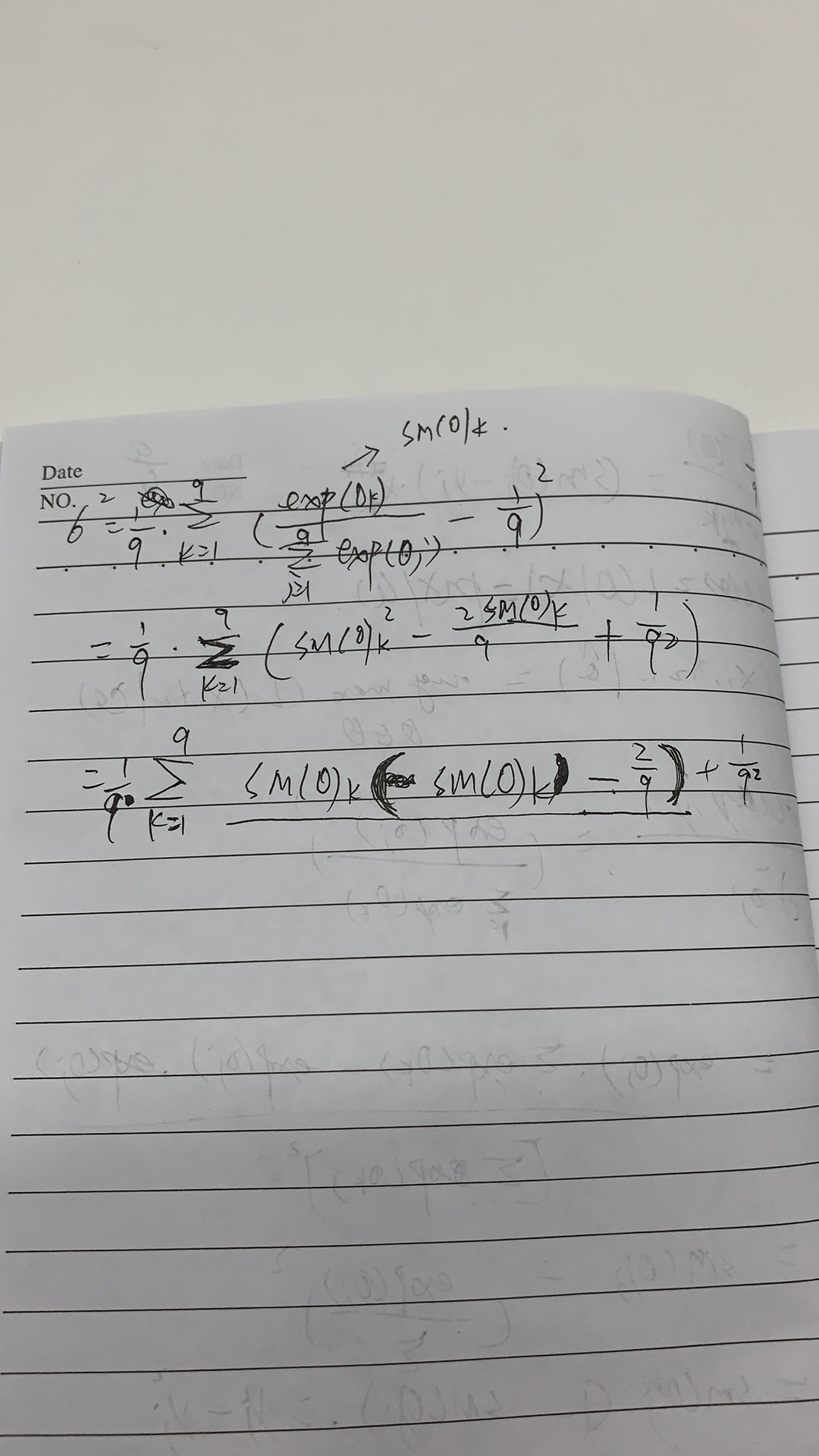
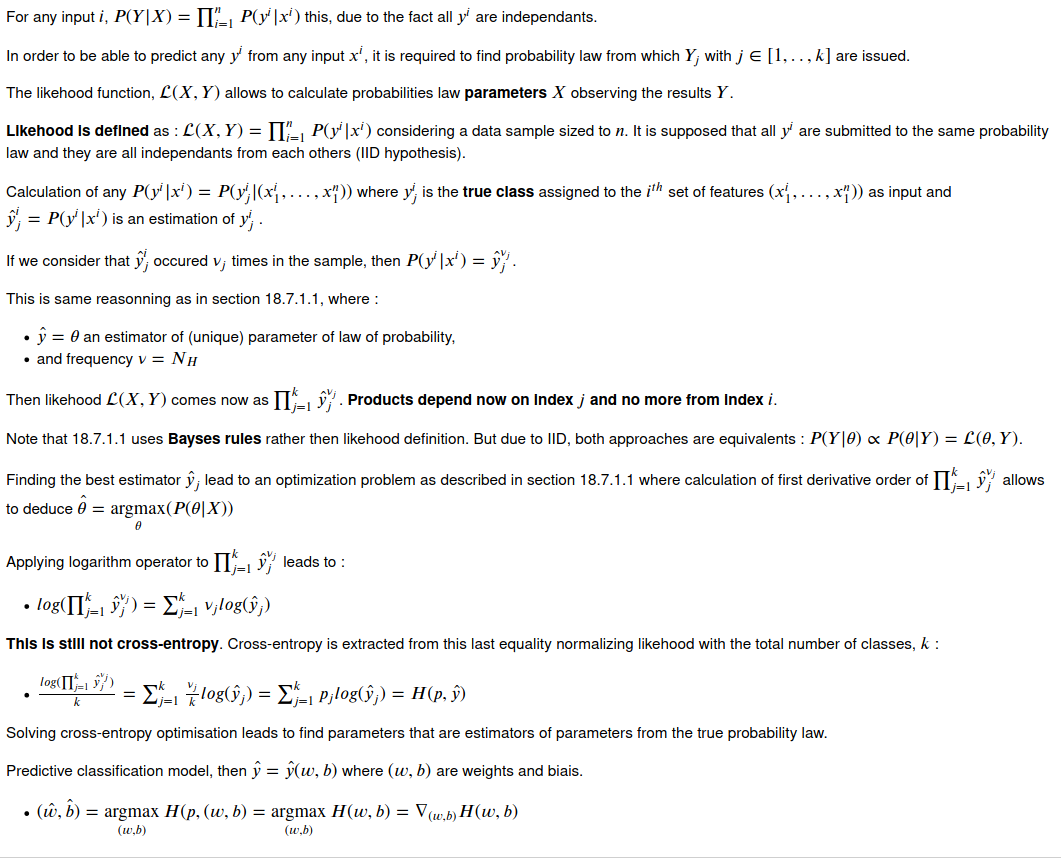
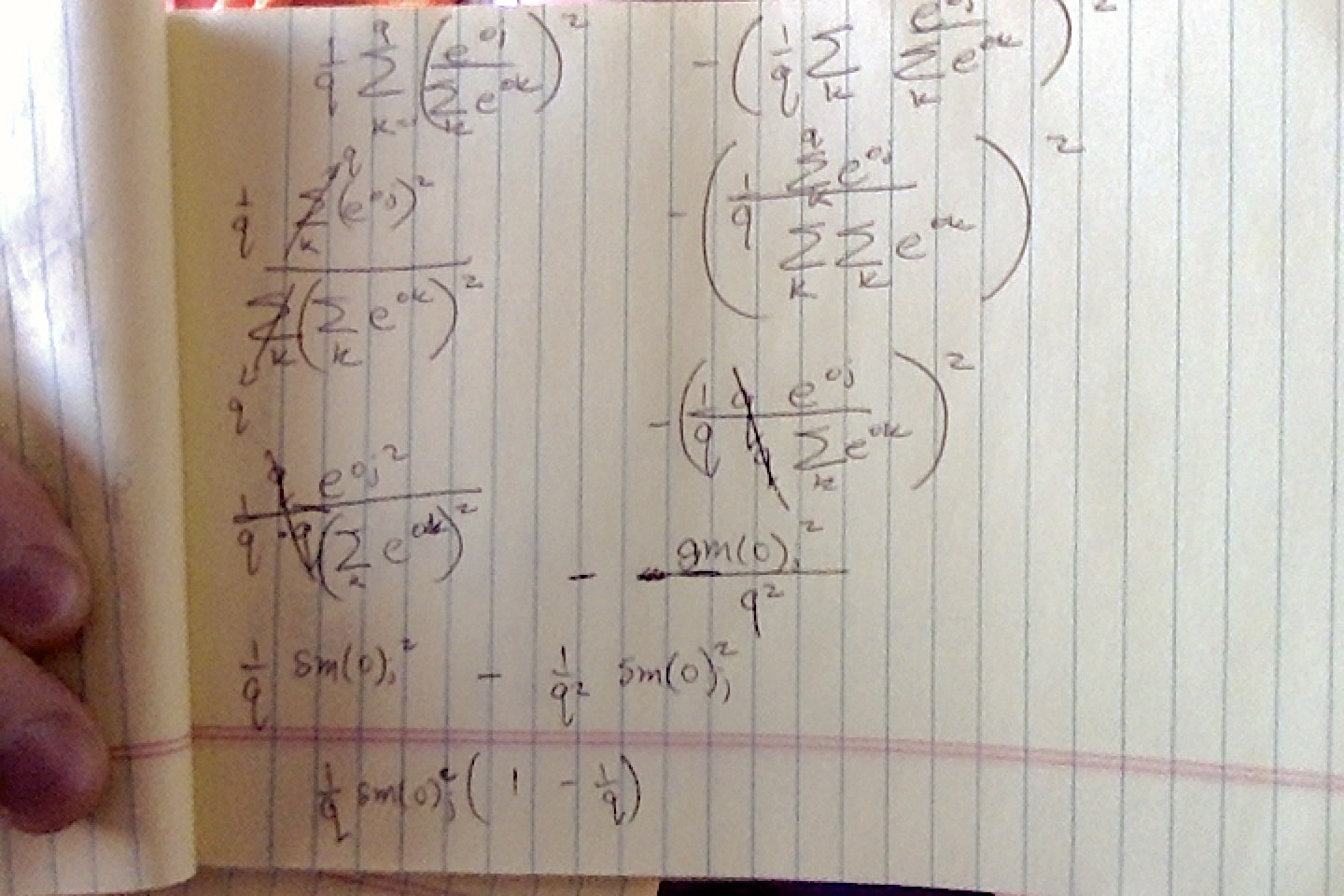
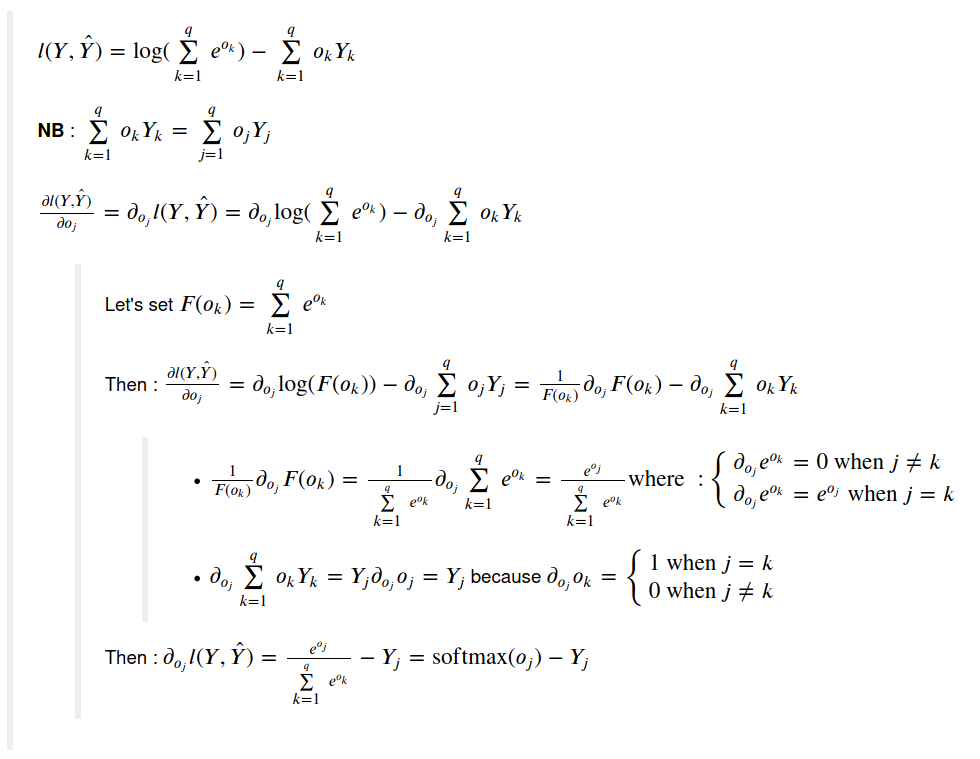
It appears that there is a reference that remained unresolved:
:eqref: eq_l_cross_entropy
in 3.4.5.3
It appears that there is a reference that remained unresolved:
:eqref: eq_l_cross_entropy
in 3.4.5.3
to keep unified form,should the yj in later two equations should have an upper right mark (i) ?
I cannot understand the equation in 3.4.9
I may have an explanation considering equivalence between log likehood and cross-entropy.
Looks like you have der(E[X]^2), but what about E[X^2]? Recall:
Var[X] = E[X^2] - E[X]^2
3.1 is strait forward to show.
I’m having trouble with 3.2 and 3.3:
3.2:
Show:
   ⎛   a      b⎞
log⎝𝜆⋅ℯ  + 𝜆⋅ℯ ⎠
──────────────── > Max(a, b)
       𝜆

Assume:
    a > b
    𝜆 > 0

(Max(a,b) -> a, b/c a > b)

   ⎛   a      b⎞
log⎝𝜆⋅ℯ  + 𝜆⋅ℯ ⎠
──────────────── > a
       𝜆

   ⎛   a      b⎞
log⎝𝜆⋅ℯ  + 𝜆⋅ℯ ⎠ > 𝜆a

(exp both sides)

   a      b    𝜆a
𝜆⋅ℯ  + 𝜆⋅ℯ  > ℯ
LHS !> RHS
and 3.3:
I did the calculus and the limit looked like it was going to zero (instead of max(a,b)) so I coded up the function in numpy to check, and indeed it appears to go to 0 instead of 4 in this case (a=2, b=4).
[nav] In [478]: real_softmax = lambda x: 1/x * np.log(x*np.exp(2) + x*np.exp(4))

[ins] In [479]: real_softmax(.1)
Out[479]: 18.24342918048927

[nav] In [480]: real_softmax(1)
Out[480]: 4.126928011042972

[ins] In [481]: real_softmax(10)
Out[481]: 0.6429513104037019

[ins] In [482]: real_softmax(1000)
Out[482]: 0.01103468329002511

[ins] In [483]: real_softmax(100000)
Out[483]: 0.000156398534760132
Please advise
thanks.but i use the definition of variance to derive while your advice is to use inference of variance to do that.both are same in fact
i think you have a mistake at the usage of ∑a/b != ∑a/∑b but ∑a / b as the denominator is public
Hi,
1.1 see 1.2
1.2
import numpy as np
output = np.random.normal(size = (10, 1))
def softmax(output):
denominator = sum(np.exp(output))
return np.exp(output)/denominator
st = softmax(output)
st_2nd = st - st**2
np.var(st)
np.var(st_2nd)
3.1 very simple to prove, just move a or b to left, we prove no matter which one moves to left, we can get [exp(a) + exp(b)]/exp(a) or [exp(a) + exp(b)]/exp(b) and both are greater than 1 so we can prove softmax is larger.
Hi,
I’m struggling with how the Softmax formula 3.4.9 is re-written (after plugging it in into the loss fct)
I think I understand the first part as you can see from my notes:
https://i.imgur.com/qOq0uuz_d.webp?maxwidth=760&fidelity=grand
However, I struggle to make sense of the lines that come after.
Is the result of 3.4.9 already the derivative, or is it only re-written? And how do they get from 3.4.9 to 3.4.10?
I’m still at the beginning of my DL journey and probably need to freshen up my calculus as well. If someone could point out to me how the formula is transformed that would be great!! I’ve been trying for a while now to write it out, but can’t seem to figure out how it should be done.
this is a great explanation of how the softmax derivative (+ backprop) works which I could follow and understand. But I have problems connecting the solution back to the (more general) formula in 3.4.9
Some help would be much appreciated! 
I have the same issue!!
Have you figured it out?
Is the result of 3.4.9 already the derivative, or is it only re-written?
3.4.9 is only the rewritten expression of lost function, not the derivative. It comes mostly from the fact log(a/b) = log(a)-log(b) and that log(exp(X)) = X
And how do they get from 3.4.9 to 3.4.10?
Please check path on the picture here-under
Hi, @goldpiggy,
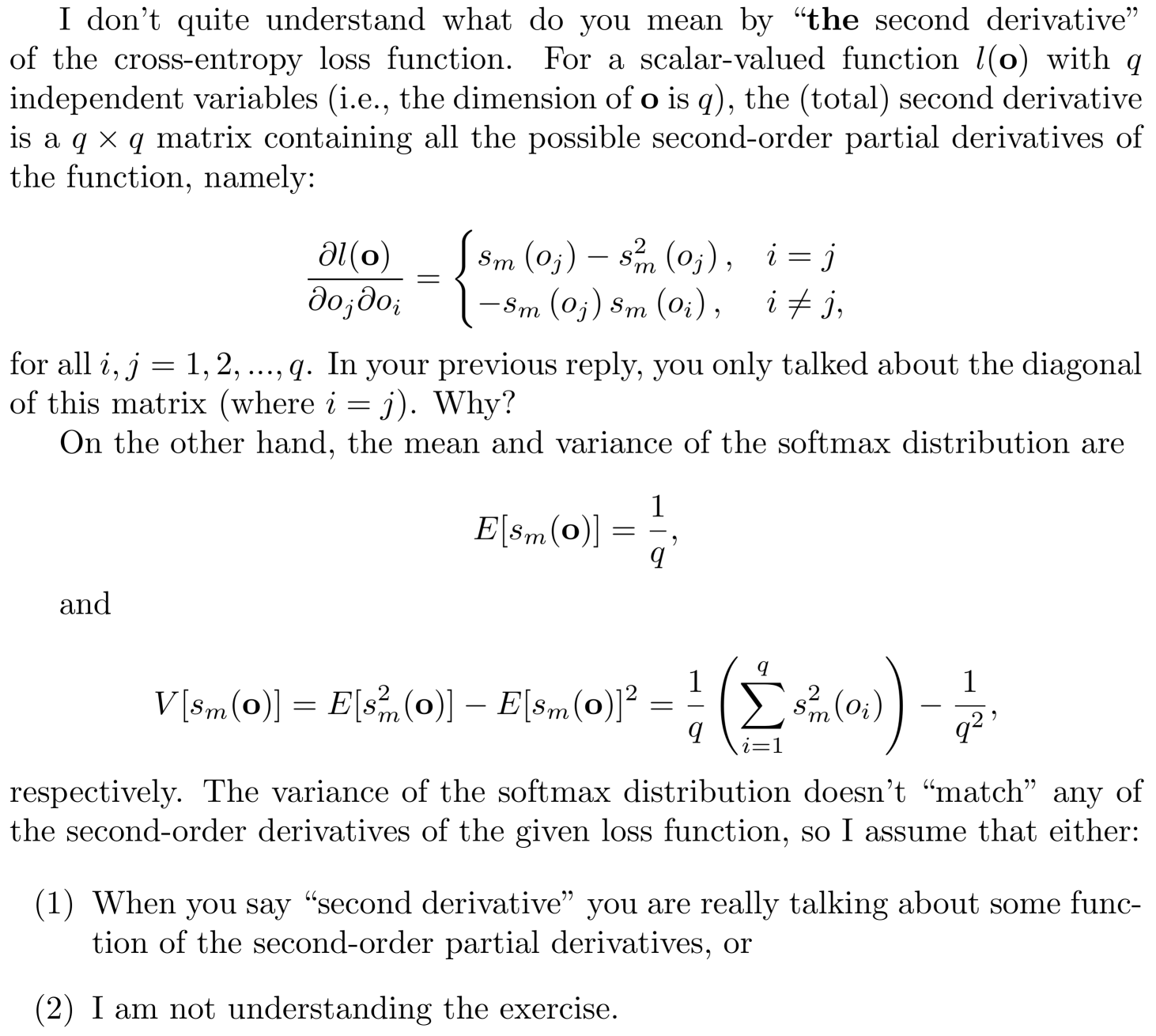
I have a question regarding Excercise 1 of this section of the book. I won’t include details of my calculations in order to keep this as simple as possible. Sorry for my amateurism, but I couldn’t render equations in this box, so I decided to upload them as images. However, because I’m a “new user” I can’t upload more than one image per comment, so I’m posting the rest of this comment as a single image file.
Could you please explain this to me? Thank you in advance for your answer :-).
Great book!
Hey @washiloo, thanks for detailed explanation. Your calculation is almost correct! The reason we are not considering i not equal to j is: you will need to calculate the second order gradient, only when you can explain o_i in some formula by o_j, or it will be zero. There blog here may also help!
Thank you for your reply, @goldpiggy ! However, I don’t understand what do you mean by “only when you can explain o_i in some formula by o_j, or it will be zero”. We are not computing the derivative of o_i with respect to o_j, but the derivative of dl/do_i (wich is a function of all o_i’s) with respect to o_j, and this derivative won’t, in general, be equal to zero. Here, d means “partial derivative” and l is the loss function, but I couldn’t render them properly.
In my early post, I wrote the analytical expression of these second-order derivatives, and you can see that they are zero only when the softmax function is equal to zero for either o_i or o_j, which clearly cannot happen due to the definition of the softmax function.
NOTE: I missed the index 2 for the second-order derivative of the loss function in my early post, sorry.
Hey @washiloo, first be aware that o_j and o_i are independent observations. i.e., o_i cannot be explained by a function of o_j. If there are independent, the derivatives will be zero. Does this helps?