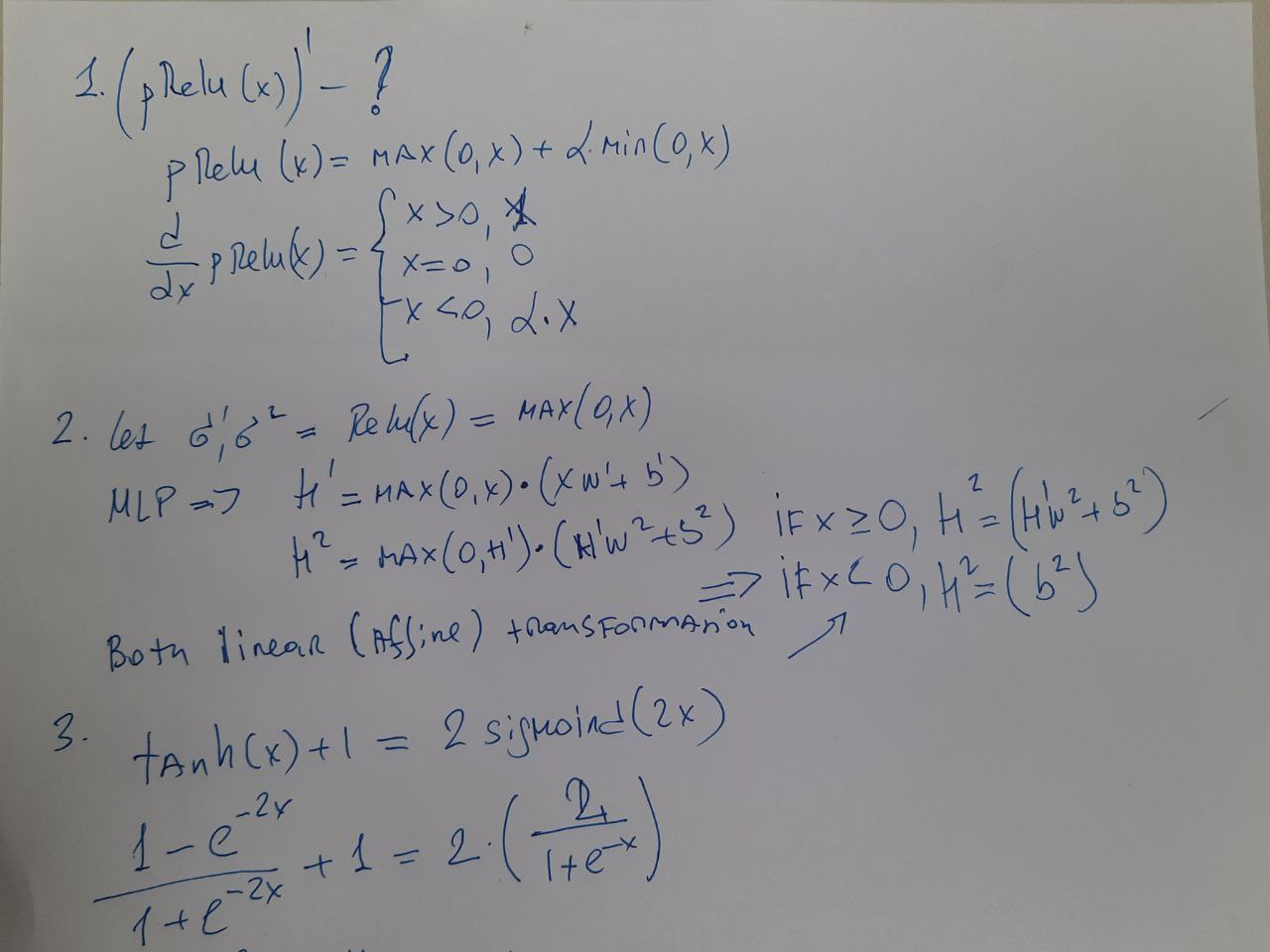
Should the equation (4.1.5) be H_1 = \sigma(X W_1 + b_1) to match the definition of the weight and input matrices defined in Section 3.4.1.3?

Hi @Andreas_Terzis, sharp eyes! Fixed here https://github.com/d2l-ai/d2l-en/pull/1050/files
As for your second question, sorry for the inconsistency. They both work, but the matrixes are in “Transposed” form. To be specific:
In equation (4.1.5), we have \mathbf{W}_1, in a dimension of (q , d); and $\mathbf{X}$ in a dimension of (d, n).
On the other hand, in equation of section 3.4.1.3, we have \mathbf{W}, in a dimension of (d, q); and $\mathbf{X}$ in a dimension of (n, d).
Let me know that is clear enough.
Thanks for the quick reply and for clarifying the differences in matrix dimensions
You can consider whether you want to explicitly mention the dimensions of \mathbf{W}_1 and \mathbf{X} in 4.1.5 to avoid confusion with the previous definitions. Doing so would also help with readers that do go through the book sequentially.
Best
1 reply
Hi @Andreas_Terzis, great feedback! We will consider your suggestions and fix it asap.

What would be the explanation for the last question? As far as I can tell, it makes little difference if we apply the activation function row-wise (which I’m guessing refers to applying the activation function to each instance of the batch one by one) or apply the function to the whole batch. Won’t both ways yield a similar result?
1 reply
Hi @Kushagra_Chaturvedy, minibatch may not be as representative as the whole batch. As a result, parameters learned from the (small) minibatch dataset may get some weird gradients and make the model harder to converge.
1 reply
Got it. But isn’t the question talking about activation functions? How will applying the activation function row-wise or batch-wise affect the learning? Also if we keep on applying the activation function row-wise for batch_size number of rows, won’t it give the same result as applying the activation function batch-wise for a single batch?
hey @Kushagra_Chaturvedy, from my understanding, the last question in the exercise was asking what if the minibatch size is 1?. In this case, the minibatch is too small to converge.


How do you write a pRelu function from scratch which can be recorded. I wrote the following
def prelu2(x,a=0.01):
    b = np.linspace(0,0,num=x.size)
    for i in np.arange(x.size):
        if(x[i] < 0):
            b[i]=a*x[i]
        else:
            b[i]=x[i]
    return b
But it doesn’t work and gives the error that inplace operations are not permitted when recording.
1 reply
Hey @asadalam, great try! One way to learn each operator is to check the source code. 

don’t understand the last question in the exercise. how could the activate function be applied to the minibatch? suppose we have 256 samples, how is this implemented and what would be the outcome? Thanks!

I have been watching many video tutorials and some books.As far as i saw this is the best But having understood the mathemathical part ,i have a problem of memorizing the programming part and also writing it by my self both with frameworks or from scratch. any help on that please…


I implemented pReLU as
def prelu(x, alpha):
    return np.maximum(0,x)+np.minimum(0,alpha*x)
But there is some interesting bug with grad of prelu (alpha=0.1):
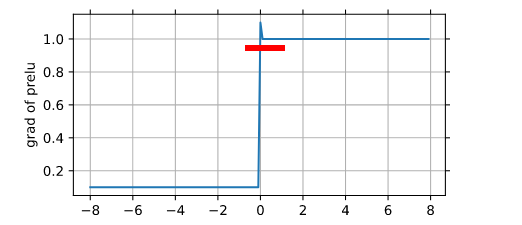
It can be fixed by shifting 0 in maximum:
def prelu(x, alpha):
    return np.maximum(0,x)+np.minimum(-1e-30,alpha*x)
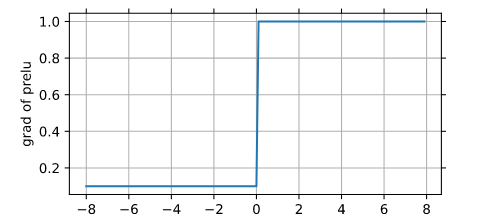
But is there a simpler and safer solution?

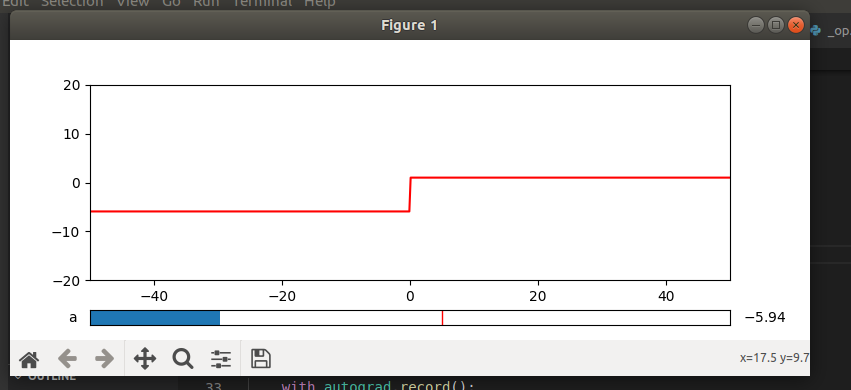
that’s my answer for pRELU
from d2l import mxnet as d2l
from mxnet import np,npx ,autograd
from matplotlib.widgets import Slider, Button
import matplotlib.pyplot as plt
npx.set_np()
a_min = 0    # the minimial value of the paramater a
a_max = 10   # the maximal value of the paramater a
a_init = 1   # the value of the parameter a to be used initially, when the graph is created

x = np.linspace(-50,50 , 500)
x.attach_grad()
fig = plt.figure(figsize=(8,3))

# first we create the general layount of the figure
# with two axes objects: one for the plot of the function
# and the other for the slider
prelu= plt.axes([0.1, 0.2, 0.8, 0.65])
slider_ax = plt.axes([0.1, 0.05, 0.8, 0.05])
plt.axes(prelu)
with autograd.record():

    u=a_init*np.minimum(0,x)+np.maximum(0,x)
u.backward()
z,= plt.plot(x, x.grad, 'r')
plt.xlim(-50, 50)
plt.ylim(-20, 20)


# the final step is to specify that the slider needs to
# execute the above function when its value changes
v=Slider(slider_ax,'a',-10,10,valinit= a_init)
def update(a):
    with autograd.record():

        u=a*np.minimum(0,x)+np.maximum(0,x)
    u.backward()
    z.set_ydata(x.grad) # set new y-coordinates of the plotted points
    fig.canvas.draw_idle()
v.on_changed(update)
d2l.plt.show()