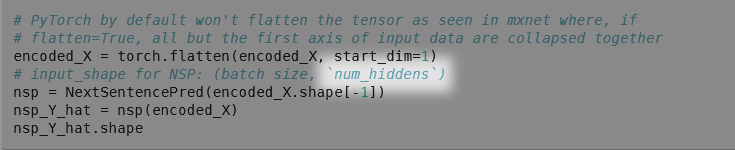
# PyTorch by default won't flatten the tensor as seen in mxnet where, if
# flatten=True, all but the first axis of input data are collapsed together
encoded_X = torch.flatten(encoded_X, start_dim=1)
# input_shape for NSP: (batch size, `num_hiddens`)
nsp = NextSentencePred(encoded_X.shape[-1])
nsp_Y_hat = nsp(encoded_X)
nsp_Y_hat.shape
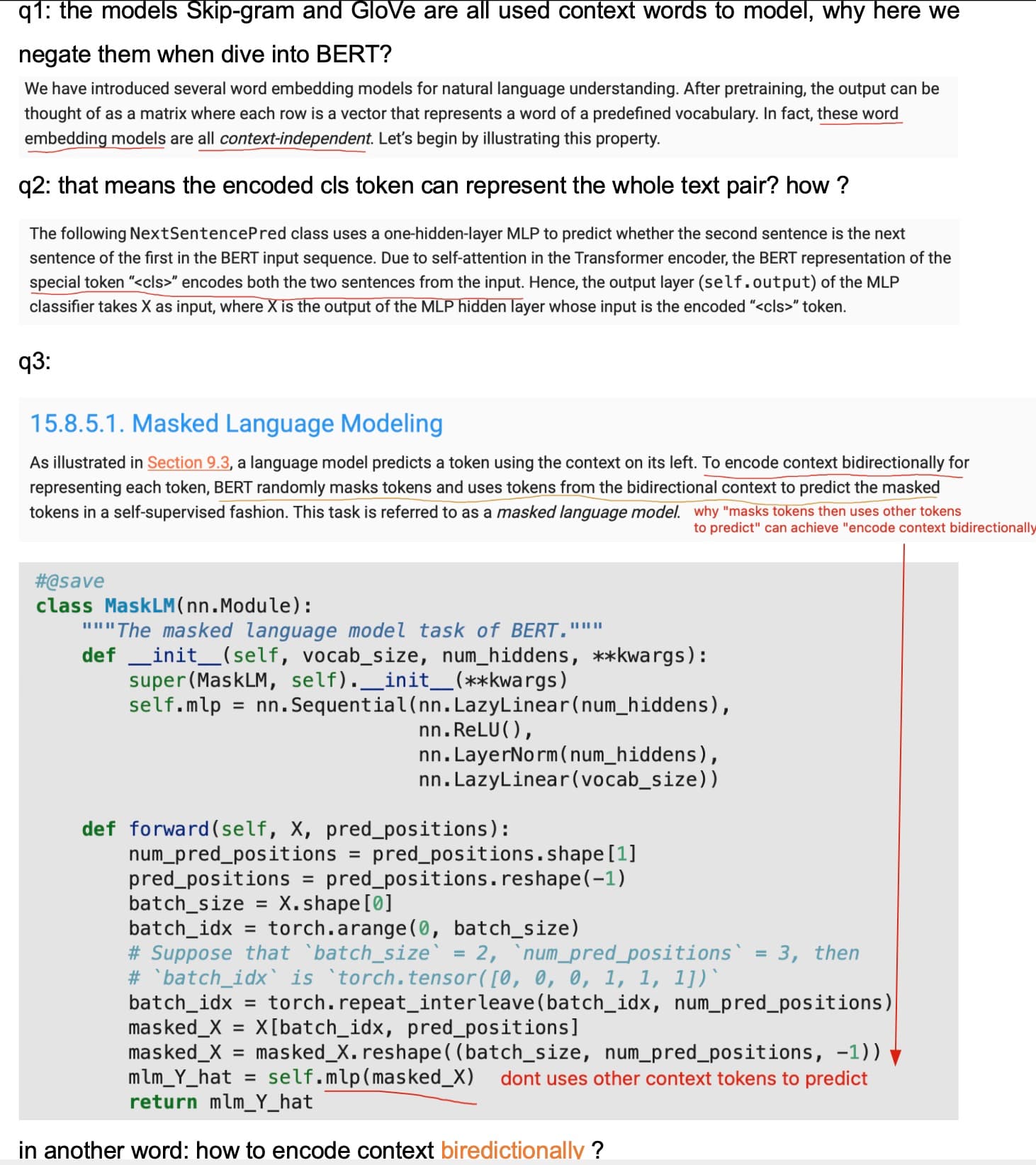
Might want to change it to something similar to nsp_Y_hat = self.nsp(self.hidden(encoded_X[:, 0, :])) in Section 6. Some quotes here:
Hence, the output layer ( self.output ) of the MLP classifier takes X as the input, where X is the output of the MLP hidden layer whose input is the encoded <cls> token.
class BERTEncoder(nn.Module):
    """BERT encoder."""
    def __init__(self, vocab_size, num_hiddens, norm_shape, ffn_num_input,
                 ffn_num_hiddens, num_heads, num_layers, dropout,
                 max_len=1000, key_size=768, query_size=768, value_size=768,
                 **kwargs):
        super(BERTEncoder, self).__init__(**kwargs)
        self.token_embedding = nn.Embedding(vocab_size, num_hiddens)
        self.segment_embedding = nn.Embedding(2, num_hiddens)
        self.blks = nn.Sequential()
        for i in range(num_layers):
            self.blks.add_module(f"{i}", d2l.EncoderBlock(
                key_size, query_size, value_size, num_hiddens, norm_shape,
                ffn_num_input, ffn_num_hiddens, num_heads, dropout, True))
        # In BERT, positional embeddings are learnable, thus we create a
        # parameter of positional embeddings that are long enough
        self.pos_embedding = nn.Parameter(torch.randn(1, max_len,
                                                      num_hiddens))

    def forward(self, tokens, segments, valid_lens):
        # Shape of `X` remains unchanged in the following code snippet:
        # (batch size, max sequence length, `num_hiddens`)
        X = self.token_embedding(tokens) + self.segment_embedding(segments)
        X = X + self.pos_embedding.data[:, :X.shape[1], :]
        for blk in self.blks:
            X = blk(X, valid_lens)
        return X
and the huggingface transformers BERT encoder
precisely they don’t seem to care about original tokens list length valid_lens
Since X is flattened, I think this should be num_hiddens*max sequence length ?
Update:
I was wrong, but still quite confused:
In BERT, we only use the <cls> in encoded_X to predict whether the next sentence is correct, so the size of input for nsp is indeed (batch_size, num_hiddens) in pre-training.
        # The hidden layer of the MLP classifier for next sentence prediction.
        # 0 is the index of the '<cls>' token
        nsp_Y_hat = self.nsp(self.hidden(encoded_X[:, 0, :]))
but as showed in the screenshot above: why do we need to flatten encoded_X in the first place? Shouldn’t it be the same as the code down below: encoded_X[:, 0, :] ?
it seems that you asked similar question twice.
the text is vapid, just focus on the code block is the right way. so the figure you given is only a demo to show how to use NSP.


 ?
?